Pool Leak Detection in Dallas, TX: Is Your Pool Losing Water Faster Than Normal?
Written by Steven Shipler, Texas Licensed Master Plumber, Responsible Master Plumber (RMP), MBA, and host of The 4 Guys Education on YouTube.
If your swimming pool is losing water faster than normal, do not ignore it. A pool leak can waste water, damage surrounding soil, affect your pool equipment, increase your water bill, and create bigger repair problems if it is not found early.
Flash Fix Plumbing, Drains, Leak Detection, Sewer Inspections, Air Conditioning, and Electrical helps Dallas and North Dallas homeowners find hidden leaks using professional leak detection methods and real diagnostic equipment.
A pool that keeps losing water may have a leak in the shell, plumbing lines, fittings, skimmer, return lines, light niche, equipment pad, or underground piping. Guessing is expensive. Proper leak detection helps find the problem before unnecessary repairs begin.
Pool Losing Water?
```Flash Fix provides pool leak detection, plumbing leak detection, drains, sewer inspections, air conditioning, electrical service, and 24/7 emergency response.
Call Now: 972-333-5448In 33 Minutes Or It’s Free. We handle all emergencies 24/7.
```How Do You Know If Your Pool Has a Leak?
Every pool loses some water from evaporation, splash-out, backwashing, and normal use. But when the water level drops faster than expected, a leak may be the reason.
Common warning signs include:
- Pool water level drops every day
- You are adding water more often than usual
- The water bill suddenly increases
- Air bubbles appear in the return lines
- The pump loses prime
- Wet spots appear around the pool deck
- Soil feels soft near the pool
- Cracks appear around the pool deck
- Pool equipment area stays wet
- Water loss continues when the pool is not being used
- The pool loses more water when the pump is running
- The pool loses more water when the pump is off
These signs do not prove the exact leak location. They prove the pool needs a real diagnosis.
Why Pool Leak Detection Matters
Pool leaks can be sneaky.
The water may disappear underground without an obvious puddle.
A leak may be in the pool shell, plumbing lines, equipment pad, suction line, return line, skimmer, main drain, light niche, or fittings.
If the wrong area is repaired first, the homeowner may spend money and still have the same water loss problem.
That is why leak detection should come before major repair decisions.
Do not start breaking concrete, replacing equipment, or digging up lines until the leak has been properly located.
Common Places Pool Leaks Hide
A pool leak may be visible, but many are not.
Common leak locations include:
- Skimmer throat
- Skimmer body
- Return fittings
- Pool light niche
- Main drain line
- Suction line
- Return line
- Cleaner line
- Equipment pad plumbing
- Pump fittings
- Filter connections
- Heater connections
- Pool shell cracks
- Tile line
- Expansion joints
- Underground pipe runs
A good leak detection visit narrows the problem instead of guessing.
Pool Leak or Evaporation?
One of the first questions is whether the pool is actually leaking or simply losing water from evaporation.
In hot Texas weather, evaporation can be noticeable. Wind, sun exposure, water temperature, air temperature, and pool use can all affect normal water loss.
But if the pool is losing water faster than normal, losing water overnight, losing water when unused, or needing constant refilling, it is time to investigate.
A simple bucket test may help homeowners compare pool water loss to evaporation, but professional leak detection is needed when the signs point to a hidden leak.
Does the Pool Lose More Water When the Pump Is Running?
This is an important clue.
If the pool loses more water when the pump is running, the leak may be on the pressure side of the system.
Pressure-side leak areas can include:
- Return lines
- Equipment pad plumbing
- Filter connections
- Heater connections
- Return fittings
- Underground pressure piping
A pressure-side leak can push water out while the system is operating.
Does the Pool Lose More Water When the Pump Is Off?
If the pool loses water even when the pump is off, the leak may be in the pool shell, fittings, light niche, skimmer, main drain, or another static water area.
Static leaks can be harder for homeowners to identify because the leak may only become obvious after the water level drops to a certain point.
Watching where the water level stops can provide clues, but professional testing is still the smarter path.
Pool Plumbing Leaks
Pool plumbing leaks may occur in underground suction lines, return lines, cleaner lines, or equipment pad piping.
Signs of pool plumbing leaks may include:
- Pump losing prime
- Air in the pump basket
- Air bubbles from returns
- Wet soil near the pool
- Water near the equipment pad
- Poor circulation
- Filter pressure changes
- Water loss that increases when pump runs
Pool plumbing leak detection may involve pressure testing, isolation testing, listening equipment, visual inspection, dye testing, or other methods depending on the symptoms.
Pool Shell and Fitting Leaks
Not every pool leak is in the plumbing line.
Leaks can also happen at the pool structure or fittings.
Common shell and fitting leak areas include:
- Cracks in the pool shell
- Skimmer connection points
- Return fittings
- Light niches
- Tile line gaps
- Main drain fittings
- Penetrations through the pool wall
These leaks may require different repairs than underground pipe leaks.
That is why locating the leak matters before choosing the repair.
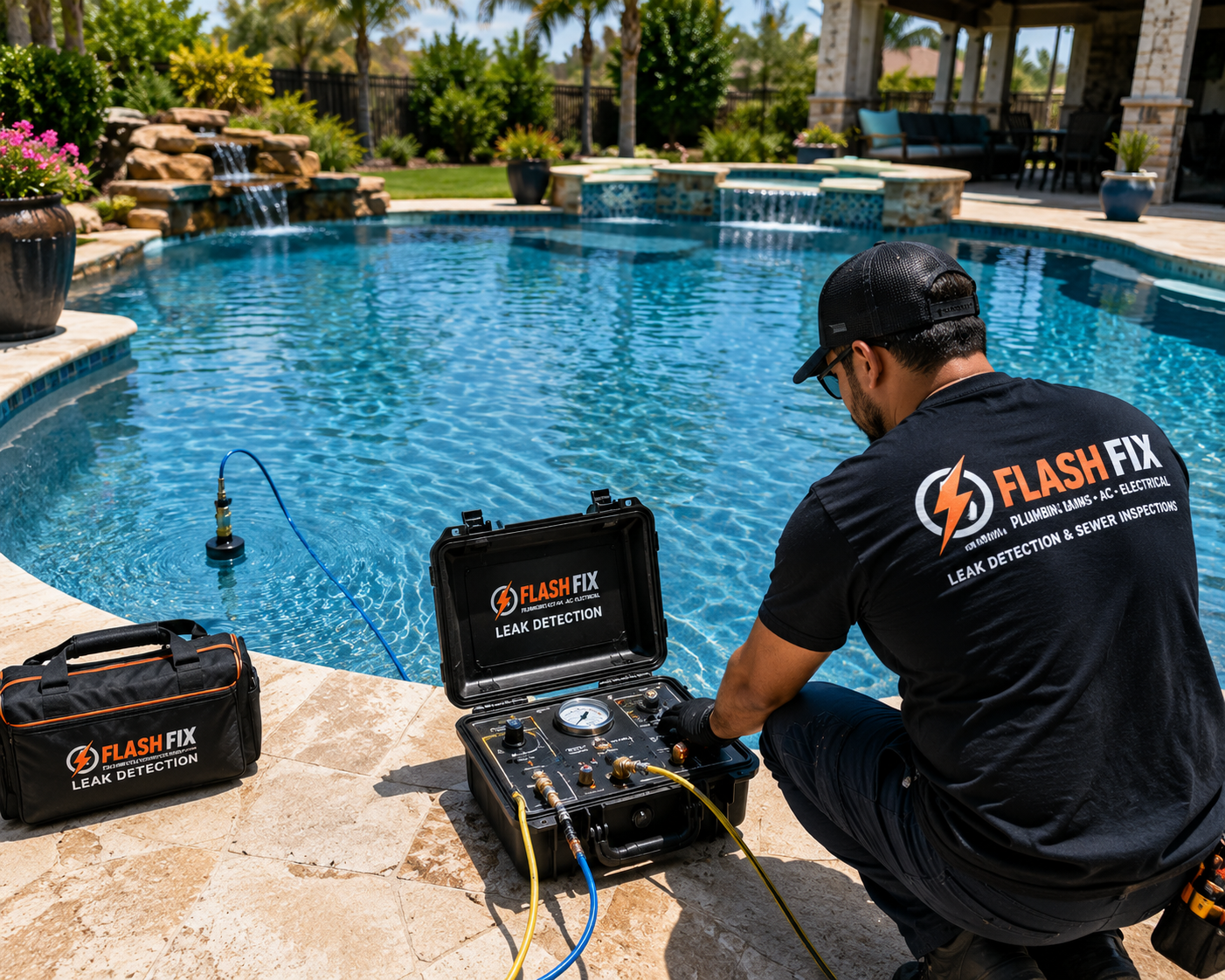
Why Flash Fix Uses Leak Detection Equipment
The image above shows a technician using professional leak detection equipment at a residential pool.
This matters because pool leak detection is not about guessing from the edge of the deck.
Depending on the situation, leak detection may include:
- Visual inspection
- Water level observation
- Pressure testing
- Line isolation
- Dye testing
- Acoustic listening
- Equipment pad inspection
- Plumbing line evaluation
- Pool shell and fitting inspection
The goal is to identify the most likely leak location before repair work begins.
Pool Leaks Can Affect More Than the Pool
A leaking pool is not just a pool problem.
Water escaping underground can affect nearby soil, decking, landscaping, foundations, retaining walls, and surrounding structures.
If the leak is near plumbing, electrical, or structural areas, it should be taken seriously.
Flash Fix also handles plumbing, leak detection, drains, sewer inspections, air conditioning, and electrical service, so we understand how one hidden water problem can connect to other home systems.
Questions to Ask Before Approving Pool Leak Repairs
Before approving a pool leak repair, ask:
- Was the leak actually located?
- Was a pressure test performed?
- Was the pool shell checked?
- Were fittings inspected?
- Was the equipment pad inspected?
- Is the leak on the suction side or pressure side?
- Is the leak underground?
- Will concrete, decking, or landscaping be disturbed?
- Is this a plumbing leak or a pool shell issue?
- What repair is recommended and why?
- What work is excluded?
- What warranty applies?
Do not accept vague answers on a hidden leak.
A hidden leak needs evidence.
When Pool Leak Detection Becomes Urgent
Some pool leaks can be scheduled.
Others need faster attention.
Call right away if you notice:
- Water level dropping several inches quickly
- Large wet areas near the pool
- Soil washing out near the deck
- Pool deck cracking or settling
- Pump losing prime repeatedly
- Air bubbles in return lines
- Water near electrical pool equipment
- Water bill suddenly increasing
- Leak near the home foundation
Flash Fix handles all emergencies 24/7.
Emergency Leak Detection Help
If your pool is losing water fast, the equipment pad is wet, or water is showing up near electrical equipment, do not wait.
Flash Fix provides pool leak detection, plumbing leak detection, slab leak diagnostics, drains, sewer inspections, AC, and electrical service.
24/7 emergency service: 972-333-5448
How Flash Fix Handles Pool Leak Detection
Flash Fix approaches pool leak detection with a simple goal:
Find the leak before selling the repair.
Step 1: Listen to the symptoms
We ask how quickly the pool is losing water, whether the pump is running, whether bubbles are visible, whether the equipment pad is wet, and whether the water level stops dropping at a certain point.
Step 2: Inspect the visible system
We look at the pool, water level, skimmers, returns, fittings, equipment pad, pump, filter, valves, plumbing connections, and surrounding area.
Step 3: Test the suspected leak area
Depending on the symptoms, testing may involve pressure testing, dye testing, line isolation, acoustic listening, or other leak detection methods.
Step 4: Explain the findings
We explain whether the evidence points to pool plumbing, the shell, fittings, equipment pad piping, or another leak source.
Step 5: Recommend next steps
The next step may be repair, further isolation, monitoring, equipment pad plumbing repair, underground line repair, or referral for specialty pool shell repair if needed.
Why Homeowners Call Flash Fix
Homeowners call Flash Fix because they want fast help, clear answers, and less guessing.
Flash Fix provides:
- Pool leak detection
- Plumbing leak detection
- Slab leak diagnostics
- Drain service
- Sewer inspections
- Air conditioning service
- Electrical service
- 24/7 emergency response
- Fast local service
- Upfront communication
The goal is not to scare the homeowner.
The goal is to find the leak and explain the options.
Schedule Pool Leak Detection Today
```If your pool is losing water, do not guess and do not start tearing up concrete without evidence.
Call Flash Fix for pool leak detection, plumbing leak detection, drains, sewer inspections, AC, electrical, and 24/7 emergency service.
Call Now: 972-333-5448In 33 Minutes Or It’s Free. 24/7 emergency response available.
```Final Answer: If Your Pool Is Losing Water, Get It Tested
If your pool is losing water faster than normal, the problem may be evaporation, but it may also be a hidden leak.
A pool leak may be in the shell, skimmer, return fittings, light niche, main drain, underground plumbing, equipment pad, suction line, return line, or another hidden location.
Do not guess.
Test it.
Flash Fix provides pool leak detection, plumbing leak detection, slab leak diagnostics, drains, sewer inspections, air conditioning, electrical, and 24/7 emergency response.
Call Flash Fix today at 972-333-5448.
Helpful Internal Links
- Pool Leak Detection Dallas TX
- Leak Detection Dallas TX
- Slab Leak Repair Dallas TX
- Plumbing Repair Dallas TX
- Drain Cleaning Dallas TX
- Sewer Inspection Dallas TX
- AC Repair Dallas TX
- Electrical Repair Dallas TX
- Contact Us
- Reviews
FAQs
How do I know if my pool has a leak?
Your pool may have a leak if the water level drops faster than normal, you add water frequently, the water bill increases, air bubbles appear in return lines, the pump loses prime, or wet spots appear around the pool or equipment pad.
Could it just be evaporation?
Yes, pools lose water from evaporation, splash-out, backwashing, and normal use. But if the water level drops faster than expected or keeps dropping when the pool is not being used, leak detection is recommended.
Where do pool leaks usually happen?
Pool leaks commonly occur at skimmers, return fittings, pool lights, main drains, suction lines, return lines, cleaner lines, equipment pad plumbing, pool shell cracks, or underground pipe runs.
Should I repair the pool before leak detection?
No. The smart move is to locate the leak first. Repairing the wrong area can waste money and leave the original leak unresolved.
Can pool leaks affect my home?
Yes. Escaping water can affect soil, decking, landscaping, retaining walls, nearby structures, foundations, and electrical equipment if the leak is severe or close to the home.
Do you handle emergency leak detection 24/7?
Yes. Flash Fix handles all emergencies 24/7. Call 972-333-5448 for pool leak detection, plumbing leak detection, drains, sewer inspections, AC, electrical, and emergency home service.