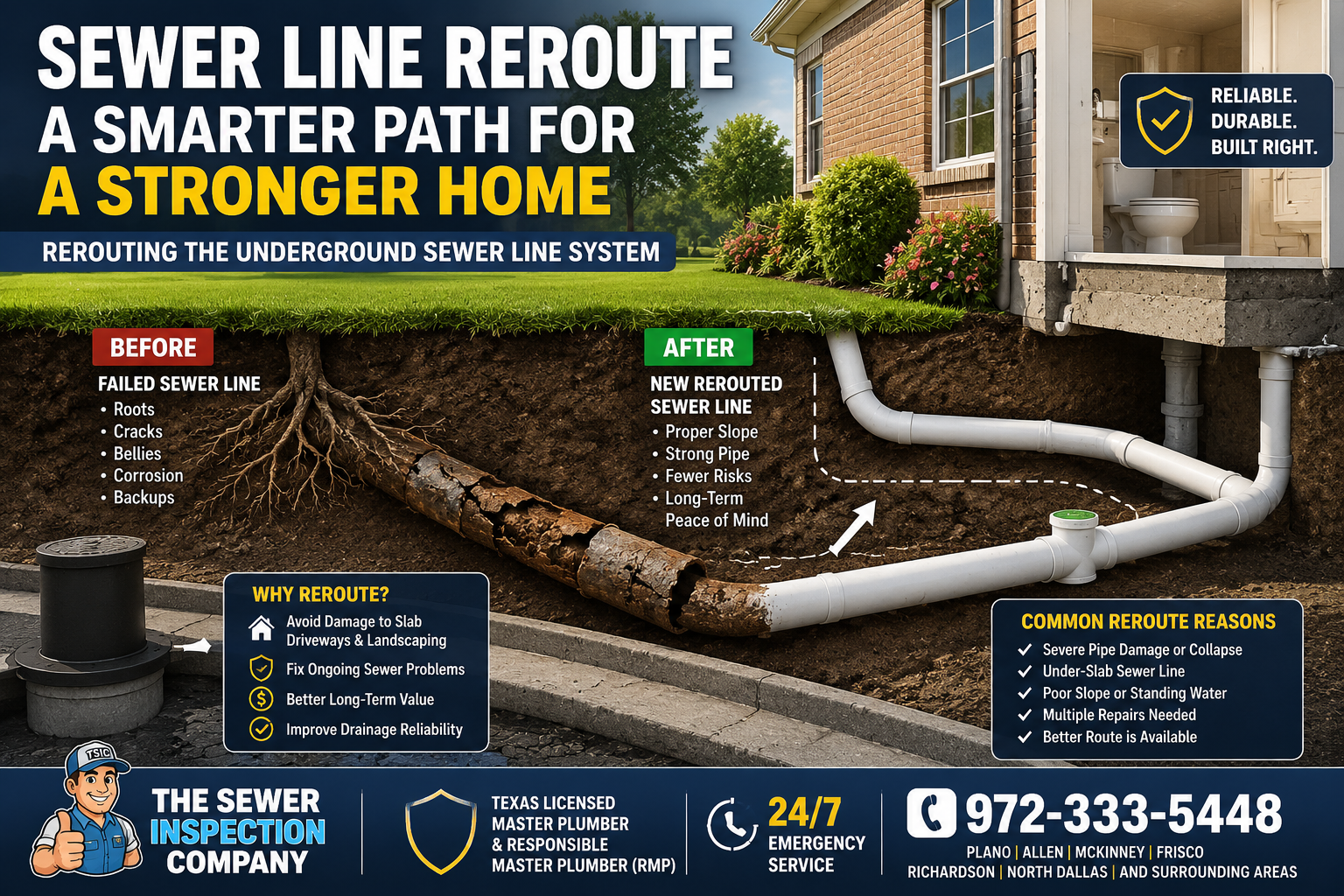
Sewer Line Reroute in Las Colinas, TX: Rerouting the Underground Sewer Line System
Written by Steven Shipler, Texas Licensed Master Plumber, Responsible Master Plumber (RMP), MBA, and host of The 4 Guys Education on YouTube.
Rerouting the underground sewer line system may be one of the smartest repair options when the existing sewer line is broken, collapsed, improperly sloped, deteriorated, inaccessible, or located under parts of the home where a traditional repair would cause excessive disruption.
A sewer line reroute means creating a new path for wastewater to leave the home instead of depending on a failed or high-risk underground sewer line. For Las Colinas homeowners, this can be a smarter long-term repair when the old sewer path runs under a slab, driveway, landscaping, mature trees, or difficult access area.
Need a Sewer Line Reroute Inspection in Las Colinas?
```Schedule a sewer camera inspection before approving major underground sewer work.
Call Now: 972-333-5448We handle all plumbing emergencies 24/7.
```What Does It Mean to Reroute an Underground Sewer Line?
A sewer line reroute means abandoning, bypassing, or replacing part of the existing underground sewer path and installing a new sewer route that carries wastewater away from the home.
Instead of repairing the same failed pipe in the same difficult location, the plumber may design a new path that avoids the worst section of pipe, reduces destructive access, improves serviceability, or creates a more reliable long-term sewer system.
A reroute is not always the right answer.
But when the existing sewer line is under the slab, under finished flooring, under a driveway, under landscaping, under a structural area, or damaged in multiple places, rerouting may be worth considering.
Why Las Colinas Homes May Need Sewer Line Rerouting
Las Colinas homes and properties can have underground sewer systems affected by age, soil movement, mature landscaping, tree roots, past repairs, under-slab pipe failures, and long sewer runs toward the city sewer connection.
A home can look clean on the outside while the underground sewer line is damaged below the yard, slab, driveway, sidewalk, or landscaping.
The toilets may still flush.
The sinks may still drain.
The seller may say everything works.
But none of that proves the underground sewer system is in good condition.
A sewer camera inspection gives homeowners and buyers visual evidence before approving a repair, replacement, or sewer line reroute.
When Sewer Line Rerouting May Make Sense
Rerouting the underground sewer line system may make sense when the existing line has major problems that are difficult, expensive, or risky to repair in place.
Common reasons to consider a sewer line reroute include:
- Broken sewer pipe under the slab
- Collapsed sewer line sections
- Multiple damaged sections in the same line
- Recurring sewer backups after cleaning
- Severe cast iron deterioration
- Heavy root intrusion in older sewer lines
- Pipe bellies holding standing water
- Improper sewer slope
- Pipe separation caused by soil or foundation movement
- Old clay or cast iron pipe that keeps failing
- Under-slab sewer lines that are hard to access
- Previous repairs that did not solve the problem
- Driveway, patio, flooring, or foundation access concerns
- A better outside route is available
The decision should be based on evidence from a sewer camera inspection, locating, testing, permit requirements, and a clear understanding of the home layout.
Do not approve a sewer reroute based on guesswork. Camera inspect, locate, test, and understand the sewer path first.
The Biggest Problem With Underground Sewer Lines
The biggest problem with underground sewer lines is simple.
Homeowners cannot see what is happening below the slab, yard, driveway, or landscaping.
The home may appear normal.
The yard may look clean.
The sewer line may still drain part of the time.
But the sewer pipe may have standing water, roots, separations, bellies, offsets, breaks, collapses, or corrosion underground.
That is why a sewer camera inspection matters before deciding whether the right repair is a spot repair, partial replacement, pipe bursting, trenchless repair, open-trench replacement, tunneling, or a full sewer line reroute.
What a Sewer Camera Inspection Shows Before a Reroute
A sewer camera inspection helps determine what is actually happening inside the pipe.
The camera may reveal:
- Root intrusion
- Standing water
- Sewer bellies
- Improper slope
- Offset joints
- Separated pipe sections
- Cracked pipe
- Broken pipe
- Collapsed sections
- Cast iron scaling
- Cast iron bottom rot
- Clay pipe separation
- PVC settlement
- Grease and sludge buildup
- Previous repairs that failed or were not verified
If the camera shows a localized defect, a spot repair may be enough.
If the camera shows repeated failures, poor slope, widespread deterioration, or a difficult under-slab route, a reroute may become a better option.
Sewer Line Reroute vs. Spot Repair
A spot repair replaces one damaged section of sewer pipe.
A reroute changes the path of the sewer line.
A spot repair may make sense when the defect is isolated and the rest of the pipe is in acceptable condition.
A reroute may make sense when the existing path is high-risk, hard to access, failing in multiple places, or not worth repairing section by section.
| Option | What It Does | When It May Make Sense | Main Concern |
|---|---|---|---|
| Spot Repair | Replaces one damaged section | One clear break, offset, root entry, or separation | Does not fix defects elsewhere |
| Partial Replacement | Replaces a longer damaged section | Several defects in one area | Existing older pipe may remain |
| Sewer Reroute | Creates a new sewer path | Existing line is under-slab, failing, poorly sloped, or hard to access | Requires proper design, slope, permits, and testing |
| Pipe Bursting | Breaks old pipe and pulls new pipe into place | Certain straight runs and suitable pipe conditions | Not right for every layout or defect |
| Full Replacement | Replaces the full sewer line | Widespread failure, collapse, severe deterioration | More invasive and higher cost |
Why a Reroute Can Be Better Than Breaking the Slab
Some sewer lines run under bathrooms, kitchens, hallways, finished floors, cabinets, tile, wood flooring, or structural slab areas.
In those cases, repairing the pipe in the original location may require cutting the slab, removing flooring, opening finished areas, and disrupting the home.
A reroute may allow the plumber to create a new path that avoids some of those interior disruptions.
This does not mean rerouting is always cheaper.
It means rerouting may reduce certain kinds of damage and may create a more serviceable system when the old path is a bad long-term bet.
Why a Reroute Can Be Better Than Repeated Drain Cleaning
Drain cleaning can open a clogged line.
But drain cleaning does not correct a broken sewer system.
If the same underground sewer line keeps backing up, the real cause may be:
- Roots inside the pipe
- Collapsed pipe
- Pipe separation
- Improper slope
- Standing water
- Cast iron deterioration
- Clay pipe separation
- A sewer belly holding debris
- Grease and sludge collecting in a low spot
If cleaning only gives temporary relief, the line needs to be inspected.
A reroute may be considered when the existing sewer path is no longer dependable.
Common Sewer Line Reroute Scenarios in Las Colinas
Las Colinas and Irving-area homes can have different sewer layouts depending on age, construction style, pipe material, foundation design, neighborhood utility layout, and prior repair history.
Common reroute scenarios include:
- Old cast iron pipe failing under the slab
- Clay pipe separating near mature trees
- Multiple sewer bellies caused by soil movement
- Failed sewer line beneath finished flooring
- Recurring backups from a line that has lost slope
- Previous spot repairs that did not solve the larger system problem
- Under-slab sewer piping that is too damaged to justify repeated access
- A sewer path that can be moved outside the foundation footprint
- A better route toward the yard, alley, street, or cleanout location
The key is not to assume.
The key is to prove the condition of the existing line and compare repair options.
How Sewer Line Rerouting Is Planned
A sewer line reroute needs a plan before digging begins.
The plumber should evaluate:
- Existing sewer line path
- Cleanout location
- Direction of flow
- Depth of the line
- Pipe material
- Location of damage
- Fixture groups served by the line
- Possible new route
- Required slope
- Existing utilities
- Driveways, sidewalks, patios, and landscaping
- Permit and inspection requirements
- Testing requirements after installation
A good sewer reroute is not just a pipe replacement.
It is a drainage design decision.
Rerouting Under-Slab Sewer Lines
Under-slab sewer problems require special care because the pipe is below the concrete foundation.
If the existing under-slab system is failing, the repair options may include:
- Opening the slab and repairing the line in place
- Tunneling under the foundation
- Replacing part of the under-slab system
- Rerouting fixtures to a new sewer path
- Installing new exterior sewer piping
- Abandoning failed sections when allowed and appropriate
The right answer depends on access, layout, pipe condition, fixtures served, city requirements, cost, and long-term reliability.
Can Every Sewer Line Be Rerouted?
No.
Not every sewer line can be rerouted easily.
A reroute may be limited by:
- Insufficient slope
- Depth of the city tap
- Home layout
- Fixture locations
- Property lines
- Driveways and hardscape
- Existing utilities
- Foundation design
- City code requirements
- Available access
Sometimes a spot repair is better.
Sometimes pipe bursting is better.
Sometimes open-trench replacement is better.
Sometimes a reroute is the best long-term option.
The decision should match the evidence.
Pipe Bursting vs. Sewer Line Reroute
Pipe bursting is a trenchless method that breaks the old pipe outward while pulling a new pipe into place.
It can reduce surface disruption compared with traditional open-trench replacement in certain situations.
A reroute is different.
A reroute creates a different path for the sewer line.
Pipe bursting may use the existing pipe path.
A reroute may avoid the existing path.
The right choice depends on the pipe condition, route, depth, bends, access pits, slope, utilities, and the condition of the existing line.
Does a Sewer Reroute Require a Permit?
In many cases, sewer line repair, replacement, or rerouting may require permits and inspections.
City requirements vary by location and scope of work.
Las Colinas homeowners should understand that Las Colinas is located in Irving, Texas, so City of Irving permit and inspection requirements may apply depending on the property and scope of sewer work.
A Responsible Master Plumber should know when permits, inspections, licensed workers, and proper supervision are required.
Testing After a Sewer Line Reroute
After a sewer line reroute, the new system should be tested and inspected as required.
Depending on the job, this may include:
- City inspection
- Pressure or water testing where required
- Slope verification
- Camera inspection
- Cleanout verification
- Backfill inspection
- Final inspection before covering
The goal is to prove the new system was installed correctly before the trench, tunnel, or access area is closed.
Warning Signs You May Need a Sewer Reroute Evaluation
You may need a sewer reroute evaluation if you notice:
- Recurring main line backups
- Multiple drains backing up
- Toilets gurgling
- Sewer smell inside the home
- Cleanout overflowing outside
- Standing water seen on camera
- Broken pipe under the slab
- Repeated cast iron drain failures
- Repeated sewer repairs in the same line
- Drain cleaning only works temporarily
- Foundation movement and sewer line issues
- Large trees near the sewer path
- Old clay, cast iron, or failing pipe material
These symptoms do not automatically mean you need a reroute.
They mean the line should be inspected and the options should be compared.
How The Sewer Inspection Company Helps With Sewer Reroute Decisions
The Sewer Inspection Company helps homeowners understand whether a sewer line reroute is reasonable before they approve major underground work.
Our process includes:
Step 1: Listen to the problem
We ask about backups, prior repairs, drain cleaning history, foundation work, mature trees, odors, and any previous sewer camera videos or reports.
Step 2: Camera inspect the sewer line
We inspect the accessible portions of the sewer line and look for standing water, roots, bellies, offsets, separations, corrosion, breaks, collapses, and poor slope.
Step 3: Locate the problem area
If the camera shows a defect, locating equipment can help identify the approximate location and depth.
Step 4: Compare repair options
We compare spot repair, partial replacement, pipe bursting, trenchless repair, open-trench replacement, tunneling, and rerouting when appropriate.
Step 5: Explain the findings in plain English
The customer should not need to be a plumber to understand the sewer system. We explain what the camera showed, what the likely cause is, and which repair options make sense.
Questions to Ask Before Approving a Sewer Line Reroute
Before approving a sewer reroute, ask:
- Was a sewer camera inspection performed?
- Can I see the video?
- Where is the existing sewer line?
- Where is the damage?
- How deep is the line?
- What pipe material is failing?
- Is this a localized defect or a system-wide problem?
- Why is rerouting better than repairing the existing line?
- What fixtures will the new route serve?
- Will the new line have proper slope?
- Will cleanouts be installed?
- Will permits and inspections be required?
- Will the line be tested before covering?
- What landscaping, concrete, flooring, or restoration work is excluded?
- What warranty applies to the sewer work?
A major sewer reroute should not be sold with pressure or fear.
It should be explained with evidence.
Why a Texas Licensed Master Plumber and RMP Matters
Sewer line rerouting is not basic drain cleaning.
It involves drainage design, pipe sizing, slope, excavation, testing, cleanouts, permits, inspections, and long-term system reliability.
A Responsible Master Plumber is responsible for the general supervision and management of plumbing work performed under contracts secured under the plumbing license.
That matters on sewer reroutes because the work must be planned, permitted, supervised, inspected, and tested correctly when required.
Steven Shipler is a Texas Licensed Master Plumber, Responsible Master Plumber (RMP), MBA, and host of The 4 Guys Education on YouTube.
Emergency Sewer Reroute Situations
Some sewer problems can be scheduled.
Others need immediate attention.
Call right away if you have:
- Sewage backing up into tubs, showers, or floor drains
- Multiple drains backing up at the same time
- An overflowing exterior cleanout
- Sewer odor inside the home
- Known broken sewer pipe under the slab
- Standing wastewater in the home
- A main sewer line that will not stay open
We handle all plumbing emergencies 24/7.
Schedule a Sewer Reroute Evaluation in Las Colinas
```If your underground sewer line is broken, collapsed, deteriorated, or failing under the slab, do not guess.
Schedule a sewer camera inspection and compare your repair options.
Call Now: 972-333-544824/7 emergency plumbing response available.
```Final Answer: Rerouting the Underground Sewer Line System in Las Colinas Can Be the Right Long-Term Repair
A sewer line reroute can be the right choice when the existing underground sewer system is too damaged, too hard to access, too poorly sloped, or too risky to keep repairing in place.
But rerouting should never be guessed.
The line should be camera-inspected, located, evaluated, permitted when required, installed with proper slope, tested, and inspected before the work is covered.
If your Las Colinas sewer line keeps backing up, has standing water, shows cast iron deterioration, has roots, has broken sections, or runs under the slab in a high-risk location, a sewer reroute may be worth discussing.
Call The Sewer Inspection Company today at 972-333-5448.
Helpful Internal Links
- Sewer Inspection Plano TX
- Drain Cleaning Plano TX
- Hydro Jetting Plano TX
- Sewer Line Repair Plano TX
- Trenchless Sewer Repair Plano TX
- Emergency Plumber Plano TX
- Contact Us
- Reviews
FAQs
What is a sewer line reroute?
A sewer line reroute means creating a new path for wastewater to leave the home instead of relying on a failed, damaged, or high-risk existing underground sewer line.
When does a sewer line reroute make sense?
A reroute may make sense when the existing line is broken under the slab, collapsed, badly deteriorated, improperly sloped, hard to access, or has multiple defects that make repeated spot repairs a poor long-term option.
Is a sewer reroute better than a spot repair?
Sometimes. A spot repair may be best for one isolated defect. A reroute may be better when the existing sewer path is failing in multiple places or is too disruptive to repair in place.
Does a sewer reroute require a permit in Las Colinas?
Many sewer line repairs, replacements, and reroutes may require permits and inspections depending on the property and scope of work. Las Colinas is located in Irving, Texas, so City of Irving requirements may apply.
Can a sewer camera inspection show whether rerouting is needed?
Yes. A sewer camera inspection can help show standing water, roots, bellies, offsets, separations, broken pipe, collapse, cast iron deterioration, and other defects that help determine whether rerouting should be considered.
Do you handle emergency sewer problems 24/7?
Yes. The Sewer Inspection Company handles all plumbing emergencies 24/7. Call 972-333-5448 for emergency sewer or drain help.
10 Outbound Citation Links
These resources support the sewer inspection, sewer blockage, trenchless repair, permitting, licensing, and structured data information discussed in this article.
```| # | Source | Why It Matters | Link |
|---|---|---|---|
| 1 | EPA — Sanitary Sewer Overflow FAQs | Explains common sewer blockage causes including roots, FOG, and wipes. | EPA SSO FAQs |
| 2 | EPA — Sanitary Sewer Overflows | Explains how sewer overflows can back up into homes and cause property damage. | EPA SSOs |
| 3 | EPA — Pipe Bursting Fact Sheet | Explains pipe bursting and how trenchless methods can reduce construction disruption. | EPA Pipe Bursting PDF |
| 4 | InterNACHI — Sewer Scope SOP | Supports sewer camera inspection through proper access points when available. | InterNACHI Sewer Scope SOP |
| 5 | TREC — Inspector Standards of Practice | Explains Texas real estate inspection standards and their minimum inspection framework. | TREC SOPs |
| 6 | TSBPE — Responsible Master Plumber | Explains RMP responsibility for supervision, permits, inspections, and licensed/registered workers. | TSBPE RMP |
| 7 | TSBPE — Master Plumber | Explains Master Plumber scope and supervision context in Texas. | TSBPE Master Plumber |
| 8 | NASSCO — PACP/LACP/MACP | Supports standardized sewer pipeline, lateral, and manhole condition assessment concepts. | NASSCO PACP/LACP/MACP |
| 9 | City of Irving — Inspections and Permits | Provides local permit and inspection resources for Irving and Las Colinas property work. | Irving Inspections |
| 10 | Schema.org — Plumber | Supports the Plumber structured data type used in the schema below. | Schema.org Plumber |